Lessons Library
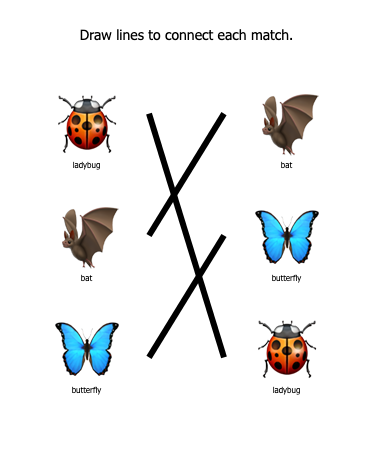
Comparing is a key aspect of learning. Given 2 columns of pictures, match each picture on the left with the same picture on the right. Explore what makes 2 pictures the same and what makes other pictures different. Matching activities introduce the concept of 1-to-1 correspondence. They help prepare students for counting.
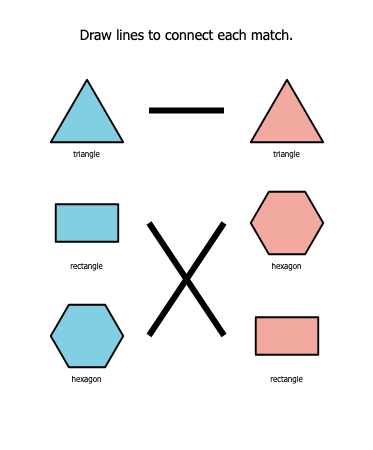
Introduce 2D shapes. Which shape on the left matches the same shape on the right? Matching sides and corners helps with one-to-one correspondence. Does a shape have an extra side or corner? Does it have more? If one shape has more, does the other shape have fewer? Match shapes to objects in the room.
Prerequisites: K-1
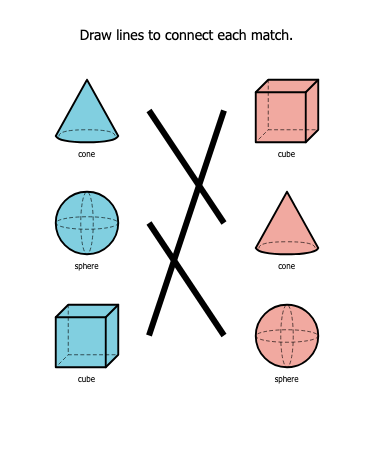
Introduce 3D solids. When possible, use real solids as well as pictures of solids. Recognize and learn their geometric names by making connections to common and familiar objects. Which solid looks like a can of soup? Which solid looks like an ice cream cone? Which looks like an ice cube? A box? A ball?
Prerequisites: K-2
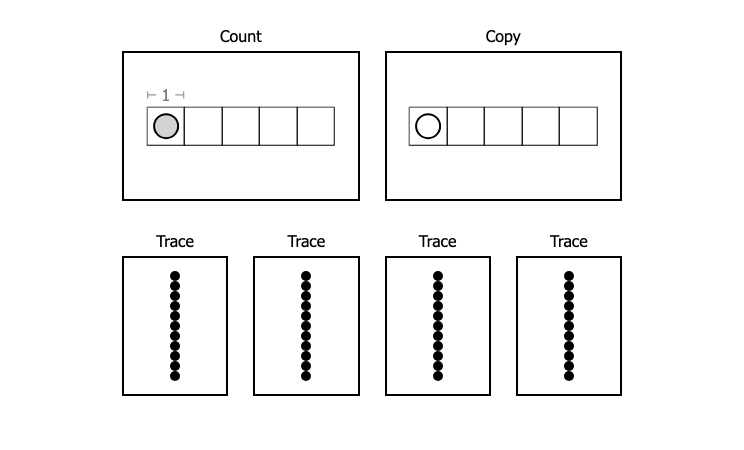
Introduce numbers to describe how many objects in a group or set. Use 1-to-1 correspondence to count and quantify the number of counters on a five frame. Emphasize that the last number counted represents the whole group of objects, not the last object. Count and draw counters on five frames. Learn digits by tracing.
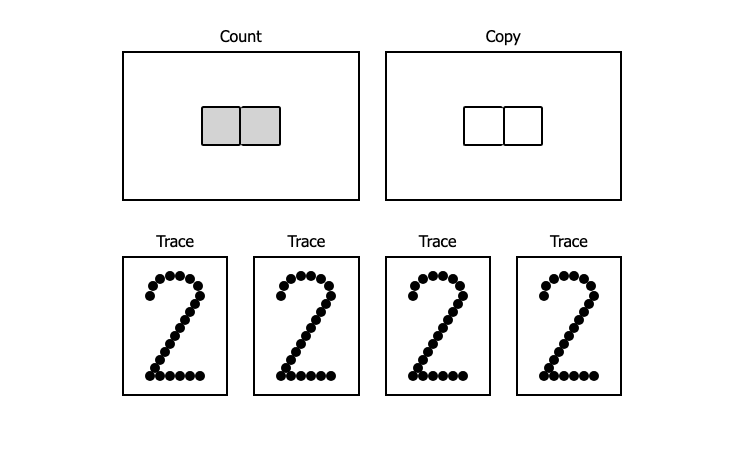
Use snap cubes as the go-to manipulative for modeling numbers concretely. They can be unsnapped or broken apart to find smaller parts. They can be snapped together or unitized to make the total or whole. Count, quantify, draw, and trace numbers to 5 using snap cubes.
Prerequisites: K-12
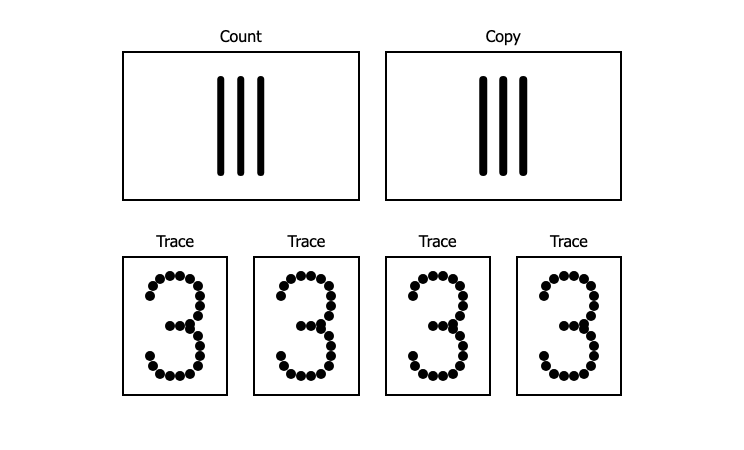
Draw tally marks to model numbers pictorially. Use straws, stirrers, and toothpicks to model concretely, and continue tracing digits to represent numbers abstractly. Why is the 5th tally drawn horizontally or diagonally instead of vertically like the other 4? Want to unitize and show 1 group of 5, instead of 5 groups of 1.
Prerequisites: K-13
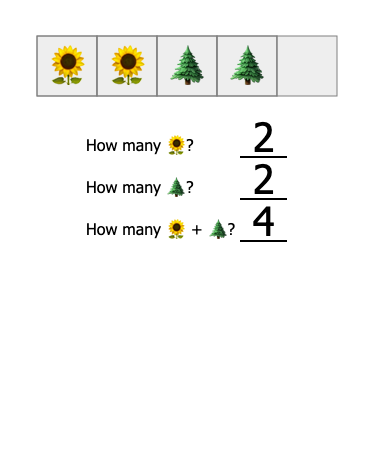
Use five frames to break a larger group – the total – into 2 smaller groups – the parts. Quantify how many are in each group, first by counting, and then by recognizing how many without counting. How many are in the first part? How many are in the second part? How many frames are empty? How many objects in all?
Prerequisites: K-26
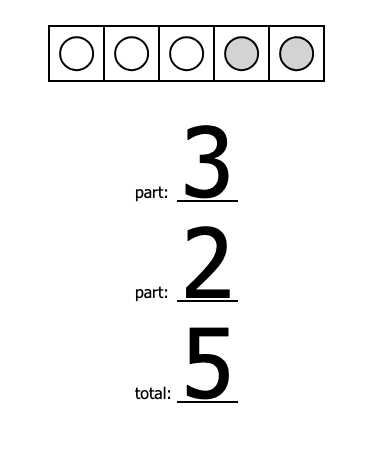
Use five frames to visually break a set of up to 5 counters into parts. Start by outlining each part. Count or subitize to know how many are in each group, and how many altogether. Recognize and read the words "part" and "total." Make sense of both by connecting the objects in the five frame with each digit being traced.
Prerequisites: K-27
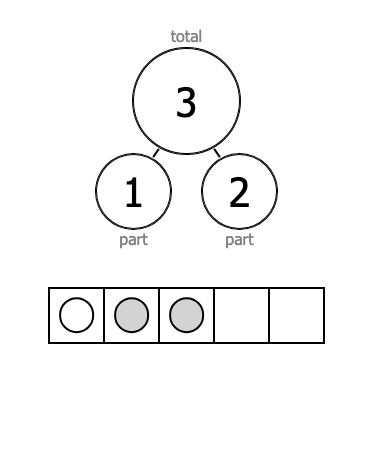
Introduce the number-bond symbol as a way to visualize the relationship between 2 parts and their total. Given 2 parts shown pictorially on a number-bond and concretely on a five frame, figure out the total – how many in all – by adding, grouping, subitizing, and counting, if needed.
Prerequisites: K-28
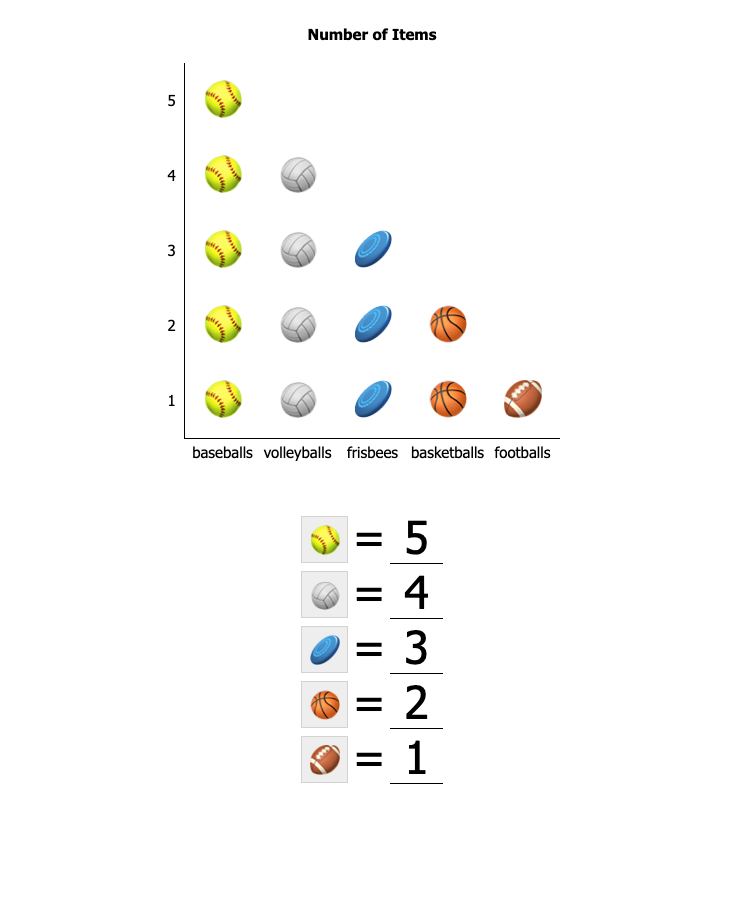
Use picture graphs to count backward and build number sense. Visually compare the number of items in each category to the number of items in the next category. Since it has 1 fewer item, the number is 1 less. Count backward to learn the number that comes before each number – a foundational skill for subtraction.
Prerequisites: K-21 ○ K-23
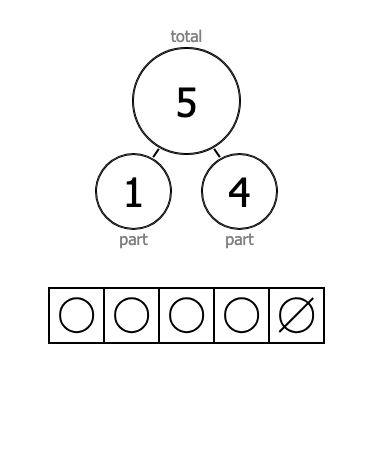
Introduce subtraction as "take away". Given the total and one of the parts on a number bond, find the other part. If the total is 5 and 1 is taken away, how many are left? Start by visualizing 5 on a five frame. Mentally cross off 1. How many are left? Draw or use counters to check that the answer is 4.
Prerequisites: K-30 ○ K-29, K-27, K-26
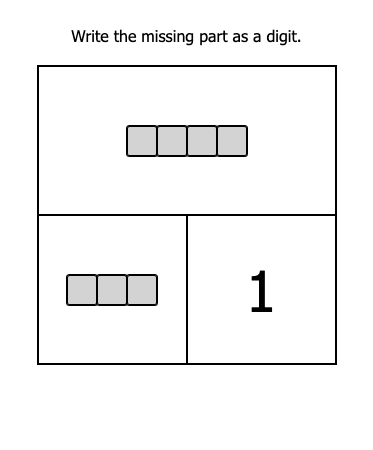
Use snap cubes, tally marks, and dice to model subtraction. Given the total and one of the parts, what's the other part? If there are 4 snap cubes and 3 snap cubes are taken away, how many snap cubes are left? Use number bonds to visualize the relationship between the 2 parts and the total. Draw to find the unknown part.
Prerequisites: K-40 ○ K-31, K-26
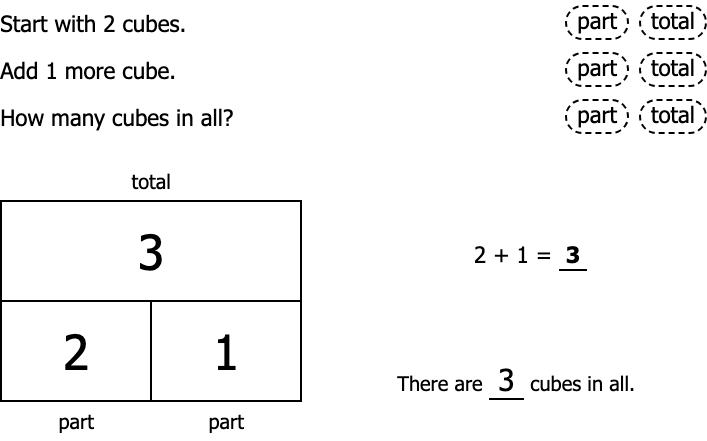
Start with learning problems – word problems that teach explicitly and don't require students to interpret context. Given the starting quantity and how much is added to it – find how many in all. Use a part-total diagram to visually show their relationship. Use snap cubes to model quantities and find the total.
Prerequisites: K-31
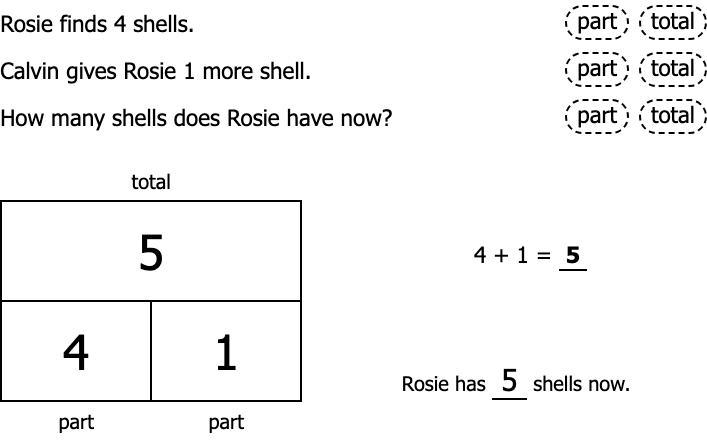
Transition to story problems that provide context and require interpretation. Given the starting quantity – the "start" – and how much is added to it – the "change" – find the sum or total – the "result." Use a part-total model to visually show their relationship. If needed, use five frames or snap cubes to do the arithmetic.
Prerequisites: K-49 ○ K-30
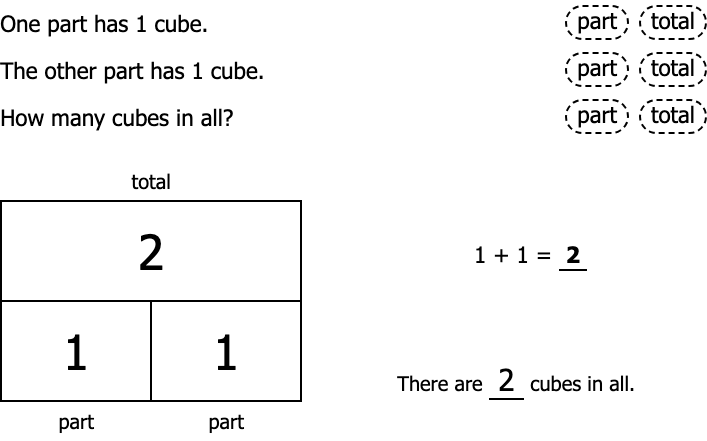
Model "Put-Together" problems. Instead of starting with one part and adding to it, start with two parts and join them together. If there is 1 cube in one part and 1 cube in the other part, how many cubes are there in all? Since 1+1=2, there are 2 cubes in all. Use a part-total model to visually show the relationship between the parts and total.
Prerequisites: K-49
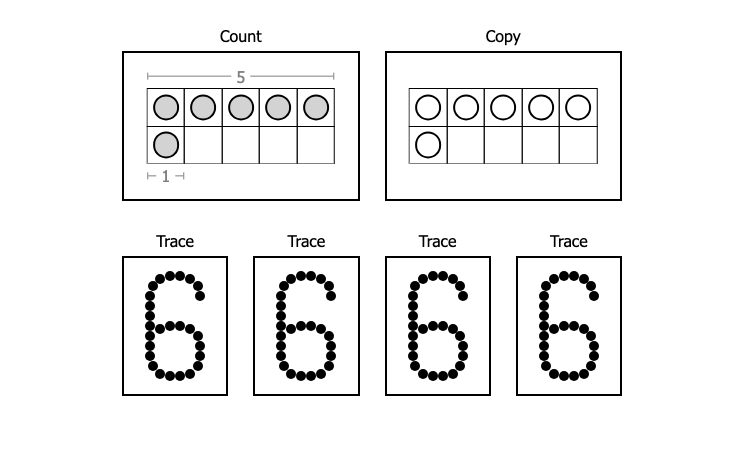
Model, count, and write numbers 6 thru 10. Use ten frames to leverage student understanding of five frames. Start modeling numbers by "anchoring" at 5. Fill the top row first, then add the rest. What's 8? 5 and 3. Later, can model 8 as 4 and 4, and 3 and 5. Learn to write the digits 6-9 by tracing.
Prerequisites: K-12
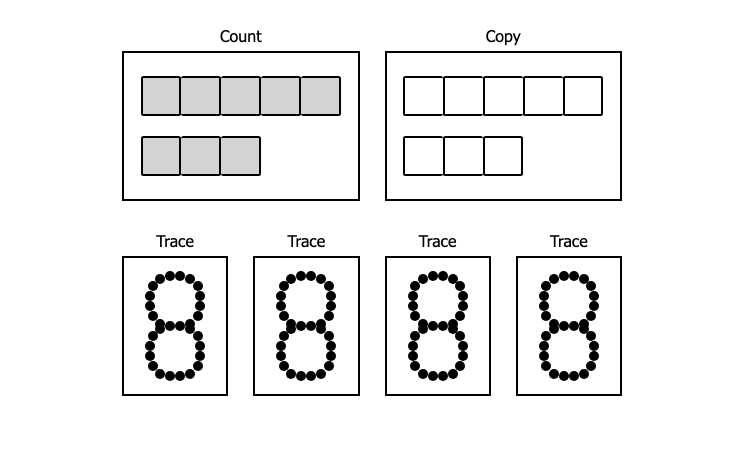
Continue to model numbers 6 to 10 as 5 plus some more. Use snap cubes – real, virtual, or drawn on paper. Snap cubes are important to use because they physically unitize ones into 1 unit. 5 ones can be 1 unit of 5. 8 ones can be 1 unit of 5 and 1 unit of 3. 10 ones can be 1 unit of 10, 2 units of 5, and many others, as well.
Prerequisites: K-59 ○ K-13
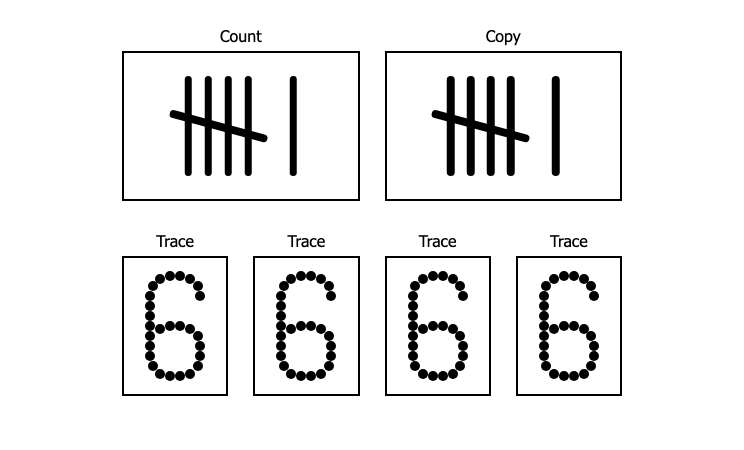
Reinforce part-whole thinking by thinking of numbers 6 to 10 as 5 and some more. Use tally marks, dice, and counters arranged in a circle to "anchor at 5" – then add the rest. What is 6? 5 and 1. What is 7? 5 and 2. Lay the groundwork for teen numbers as 10 and some more and numbers in the twenties as 20 and some more.
Prerequisites: K-60 ○ K-16, K-15, K-14
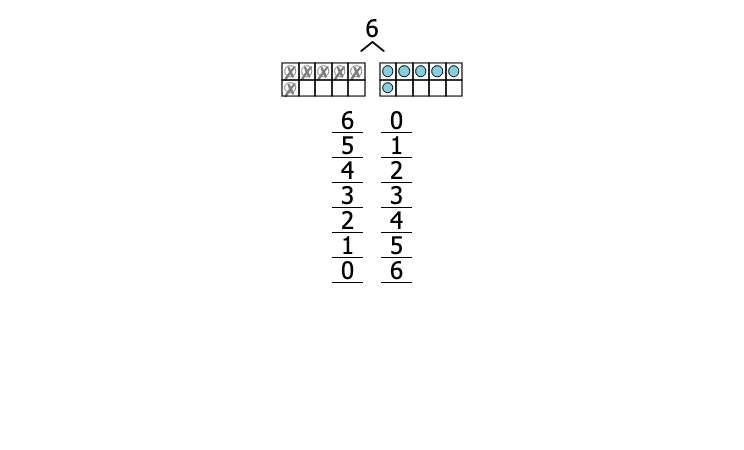
Shift 1 to find all the ways to make the numbers 6 thru 10. Discover and apply the commutative property. When the 2 parts are different, is there another number bond with the parts reversed? Is there a short cut for finding all the number bonds? Shift 1 to find a new number bond, then reverse the parts to find another one.
Prerequisites: K-56
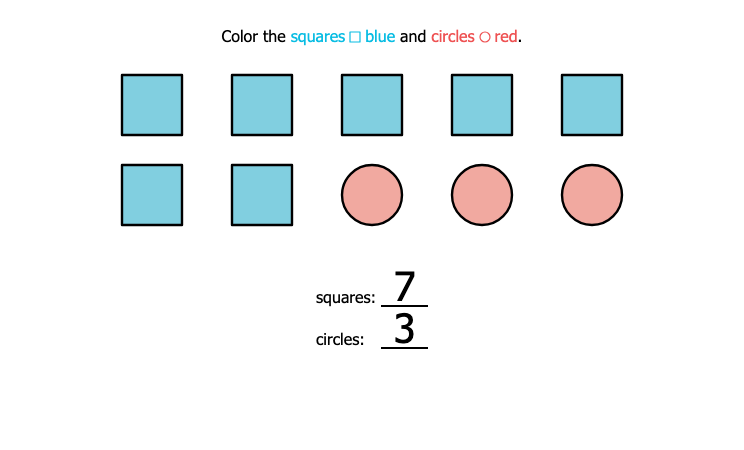
Use "imaginary" ten frames to model combinations of 10 with flat shapes and 3-dimensional solids. Identify both parts and the total using grouping instead of counting strategies. Start by showing parts in familiar ways – 7 is full top row plus 2 more. Generalize to less familiar and more creative ways to think about numbers.
Prerequisites: K-74 ○ K-67, K-3, K-2
Enrich by using "imaginary" ten frames to model combinations of 10. Generalize by finding 3 parts instead of just 2. Identify all 3 parts and the total using grouping instead of counting strategies.
Prerequisites: K-75
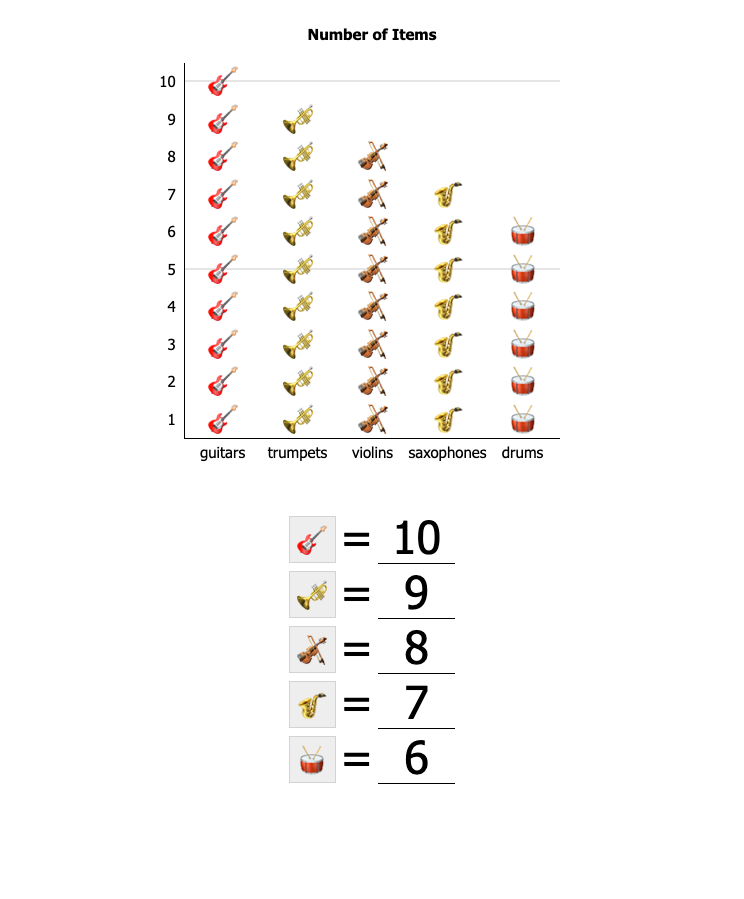
Use picture graphs to count backward and build number sense. Visually compare the number of items in each category to the number of items in the next category. Since it has 1 fewer item, the number is 1 less. Count backward to learn the number that comes before each number – a foundational skill for subtracting.
Prerequisites: K-64 ○ K-66
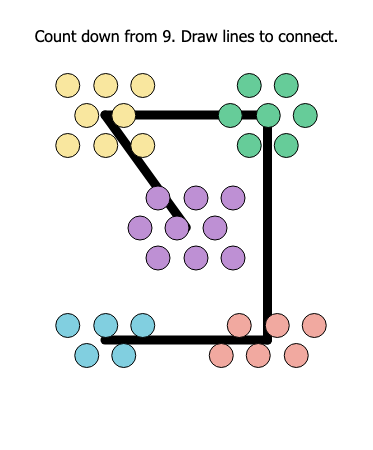
Build number sense by thinking about numbers in decreasing order. Represent numbers as groups of discrete objects. Use grouping strategies to quantify, without counting, how many in each group. Draw a line from the largest group or number to the next largest until all the numbers are connected.
Prerequisites: K-66
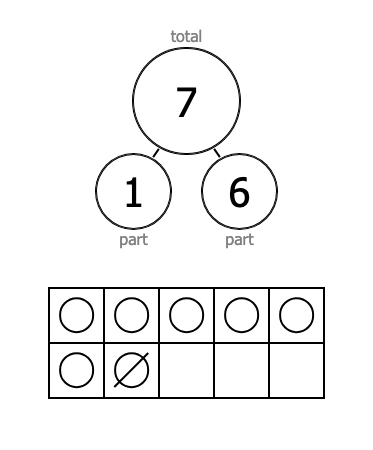
Use number bonds and ten frames to find the unknown part. Given the total amount ("start") and the part taken away ("change"), find the part that's left ("result"). Imagine the total as counters or circles on a ten frame. Mentally take away or cross off part. How many are left? Check for accuracy by drawing.
Prerequisites: K-87 ○ K-86, K-48
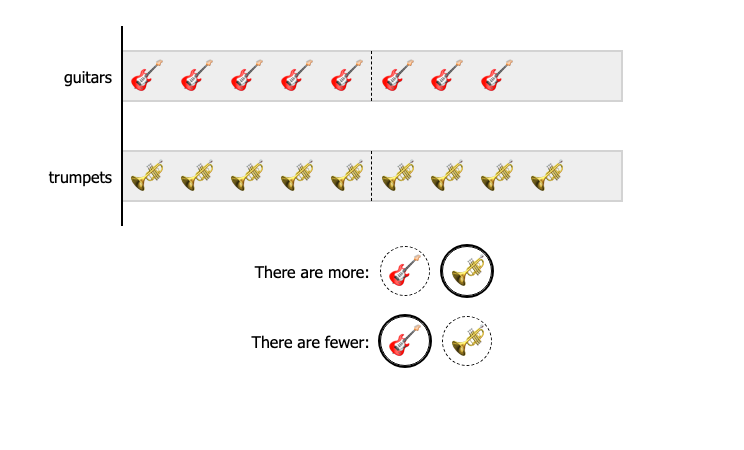
Compare the objects in 2 groups visually using a linear model. Compare without knowing how many are in either group. Focus instead on the extra objects in the group with more, or the missing objects in the group with fewer. Learn the comparison word "more" and the more difficult comparison word "fewer."
Prerequisites: K-63 ○ K-62
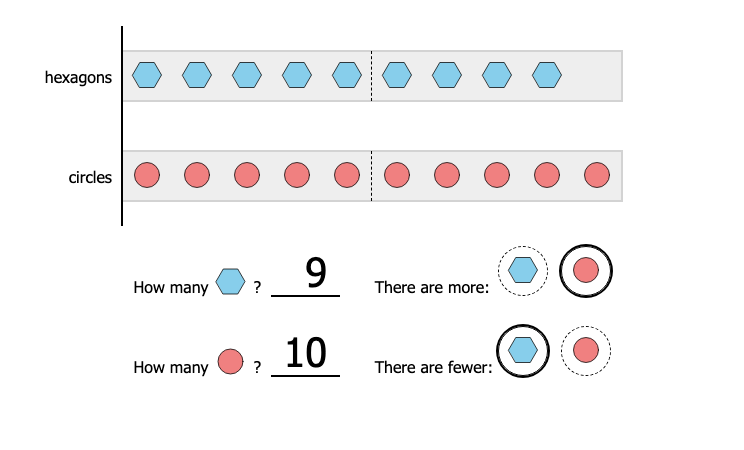
Use a linear model to quantify and compare the objects in 2 groups. Figure out how many are in each group by counting, grouping, adding, and comparing. Which group has more? Circle the extra objects. Which group has fewer? Circle the spot where objects are missing. This lays the foundation for finding the difference, later.
Prerequisites: K-99
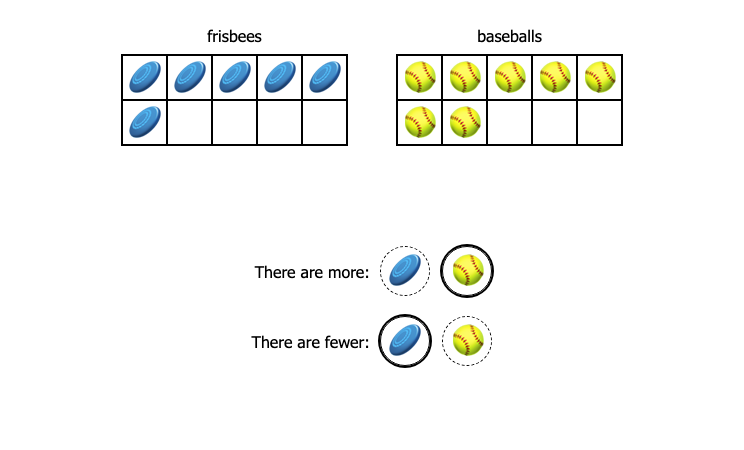
Now compare numbers modeled with ten frames. Encourage part-total thinking by using a compare-the-parts strategy. To compare larger totals, first find parts that are the same and balance each other out – like the top rows. Now just compare the parts that are left. Comparing smaller parts is easier than comparing larger totals.
Prerequisites: K-100 ○ K-99, K-62
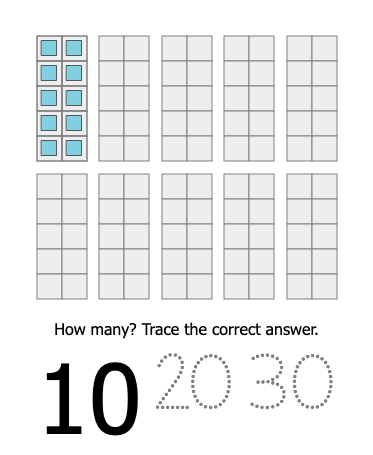
Transition from counting by ones to counting by tens. Model multiples of 10 with ten frames to connect each name with a concrete, visual image. When counting, reinforce Base 10 thinking by saying the quantity, place value, and total value. "1 ten is 10, 2 tens is 20, 3 tens is 30." When ready, skip count. "Ten, twenty, thirty."
Prerequisites: K-112
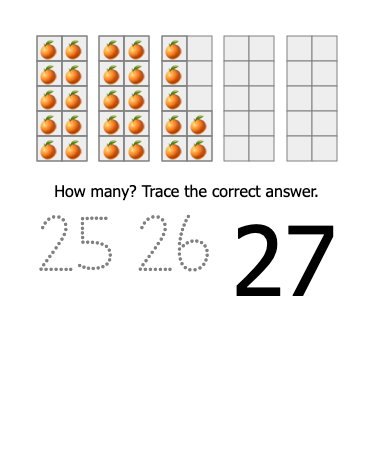
When counting, make sense of numbers and number names by grouping objects in tens and ones. Use vertical ten frames so students can subitize and keep track of how many they have counted. Emphasize that the last number counted represents the whole set of objects, not the last object counted.
Prerequisites: K-113
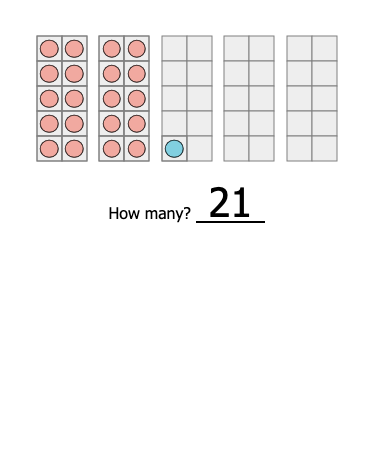
Use quick images to encourage Base 10 thinking. Subitize how many by thinking in groups of ten with ten frames, instead of counting. Start by asking how many. Progress to asking how many more make another 10 and the next multiple of 10. When ready, ask both questions. Limit processing time to develop fluency.
Prerequisites: K-114
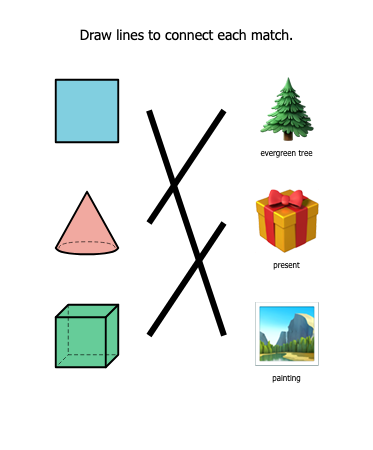
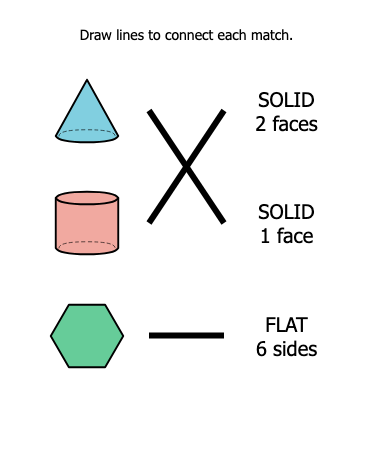
Help students recognize, understand, and remember the names of flat and solid shapes by connecting them to more familiar objects. What is shaped like a cube – a tree, a present, or a picture on a wall? Associating shapes and common objects makes it easier to learn their names and visualize what they look like.
Prerequisites: K-6
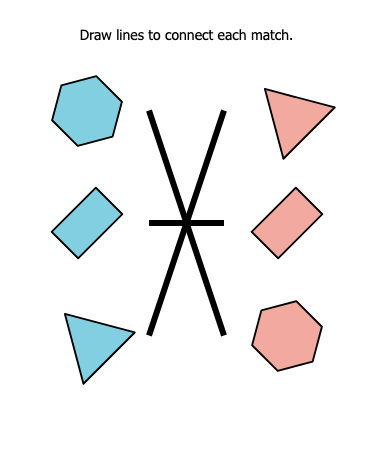
If a rectangle is rotated, is it still a rectangle? What if it's sized larger or smaller? In either case, it is still a rectangle. Orientation and size are "non-defining attributes." They describe shapes and solids, but don't define them. Match shapes and solids, and explore what makes them the same or different.
Prerequisites: K-121 ○ K-8
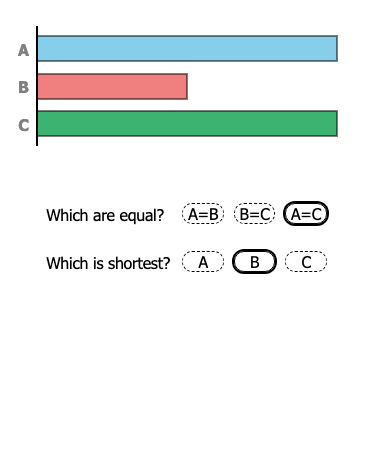
To prepare for fractions, apply the concept of "equal" to length. Use the equal symbol (=) to mean "has the same length as." "B = C" means "B has the same length as C." Given 3 colored bars – A, B, and C – which 2 bars are the same length? Which bar is the longest? Which bar is the shortest?
Prerequisites: K-71 ○ K-88
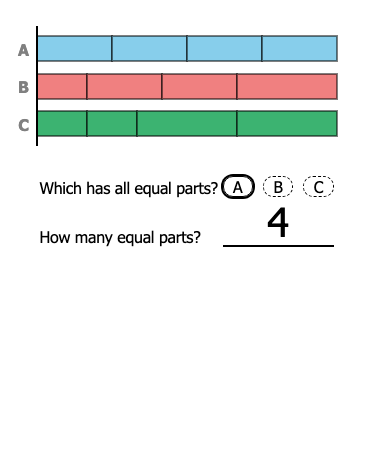
Introduce fractional parts that are equal in size and together make the whole. Use length models – colored rods, strips of paper, drawn bars – to model part-whole relationships. Which bar has equal parts? How many equal parts? What is the name of each part? Learn 2 halves, 3 thirds, and 4 fourths make the whole.
Prerequisites: K-131
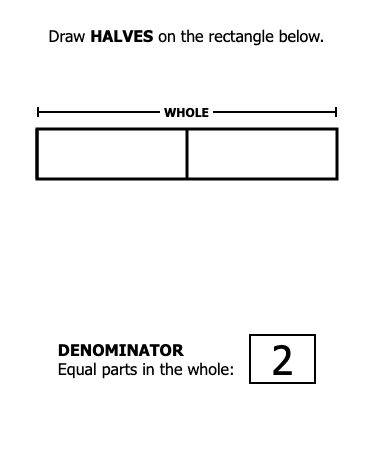
Draw fractions by dividing a bar into equal parts. To draw 2 halves, draw a dot in the middle of the bar and a vertical line thru the dot. To make 4 fourths, draw dots in the middle of each half and 2 more vertical lines thru the dots. To draw 3 thirds, practice drawing 2 vertical lines that make 3 equal parts. Generalize to area.
Prerequisites: K-132
Additional Resources
Kindergarten math centers on two main critical areas: representing, relating, and operating on whole numbers (starting with concrete sets of objects) and describing shapes and space. Students build foundational number sense by learning to count to 100 by ones and tens, recognize and write numbers from 0 to 20, and understand that each successive number name refers to a quantity that is one more. They count objects to tell "how many," compare numbers (using terms like greater than, less than, or equal to), and begin to model simple addition and subtraction as "putting together" or "taking apart" within 10. Place-value foundations emerge as students work with numbers 11-19, decomposing them into tens and ones. Measurement and data concepts introduce describing and comparing measurable attributes (length, weight, capacity) using direct comparison rather than tools. They classify objects into categories, count the number in each, and sort by attributes. Geometry focuses on identifying, naming, and describing basic two- and three-dimensional shapes (squares, circles, triangles, rectangles, cubes, cones, cylinders, spheres) in various orientations and sizes, while exploring spatial relationships like above, below, beside, and in front of. Throughout the year, students use concrete objects, drawings, and manipulatives to develop these ideas, laying the groundwork for more abstract thinking in later grades.
K.CC.2 Count forward beginning from a given number (instead of having to begin at 1).
K.CC.3 Write numbers from 0 to 20. Represent a number of objects with a written numeral 0-20. Count to tell the number of objects.
K-12, K-13, K-14, K-15, K-16, K-24, K-59, K-60, K-61, K-62, K-103
K.CC.4 Understand the relationship between numbers and quantities; connect counting to cardinality. When counting objects, say the number names in the standard order, pairing each object with one and only one number name and each number name with one and only one object.
K-17, K-18, K-19, K-22, K-23, K-65, K-66, K-90, K-106, 1-6, 1-11
K.CC.5 Count to answer "how many?" questions about as many as 20 things arranged in a line, rectangular array, or circle, or as many as 10 things in a scattered configuration; given a number from 1-20, count out that many objects.
K-20, K-21, K-24, K-25, K-26, K-27, K-39, K-62, K-63, K-64, K-67, K-68, K-72, K-73, K-77, K-89, K-100, K-102, K-103, K-104, K-105, K-107, K-108, K-109, K-110, K-115, K-118, 1-1, 1-2, 1-3, 1-4, 1-5
K.CC.6 Identify whether the number of objects in one group is greater than, less than, or equal to the number of objects in another group (e.g. matching & counting).
K-20, K-21, K-63, K-64, K-89, K-99, K-100, K-101, K-102, K-107, K-108, 1-4, 1-5
K.OA.1 Represent addition and subtraction with objects, fingers, mental images, drawings, sounds, acting situations, verbal explanations, expressions, or equations.
K-28, K-29, K-30, K-31, K-32, K-33, K-34, K-40, K-41, K-42, K-43, K-44, K-78, K-79, K-80, K-81, K-82, K-83, K-86, K-87, K-91, K-92, K-94, K-95, K-96, 1-8, 1-13
K.OA.2 Solve addition and subtraction word problems, and add and subtract within 10 (e.g. by using objects or drawings to represent the problems).
K-49, K-50, K-51, K-52, K-53, K-54, K-55, K-57, K-58, K-84, K-85, K-97, K-98, 1-9, 1-10, 1-14, 1-15
K.OA.3 Decompose numbers less than or equal to 10 into pairs in more than one way (e.g. by using objects, record each decomposition by a drawing or equation (ex 5=2+3 and 5=4+1).
K.OA.4 For any number from 1 to 9, find the number that makes 10 when added to the given number, e.g., by using objects or drawings, and record the answer with a drawing or equation.
K.OA.5 Fluently add and subtract within 5.
K-32, K-33, K-34, K-36, K-37, K-38, K-42, K-43, K-44, K-46, K-47, K-48, 1-7, 1-12
K.NBT.1 Compose and decompose numbers from 11 to 19 into ten ones and some further ones, e.g., by using objects or drawings, and record each composition or decomposition by a drawing or equation (such as 18 = 10 + 8); understand that these numbers are composed of ten ones and one, two, three, four, five, six, seven, eight, or nine ones.
K.MD.1 Describe measurable attributes of objects, such as length or weight. Describe several measurable attributes of a single object.
K.MD.2 Directly compare two objects with a measurable attribute in common, to see which object has more of/less of the attribute, and describe the difference. For example, directly compare the heights of two children and describe one child as taller/shorter.
K.MD.3 Classify objects into given categories; count the numbers of objects in each category and sort the categories by count.
K.G.1 Describe objects in the environment using names of shapes, and describe the relative positions of these objects using terms such as above, below, beside, in front of, behind, and next to.
K.G.2 Correctly name shapes regardless of their orientations or overall size.
K.G.3 Identify shapes as two-dimensional (lying in a plane, "flat") or three-dimensional ("solid").
K.G.4 Analyze and compare two- and three-dimensional shapes, in different sizes and orientations, using informal language to describe their similarities, differences, parts (e.g., number of sides and vertices/"corners") and other attributes (e.g., having sides of equal length).
K.G.5 Model shapes in the world by building shapes from components (e.g., sticks and clay balls) and drawing shapes.
K.G.6 Compose simple shapes to form larger shapes. For example, "Can you join these two triangles with full sides touching to make a rectangle?"
