Put-Together Learning Problems K-51

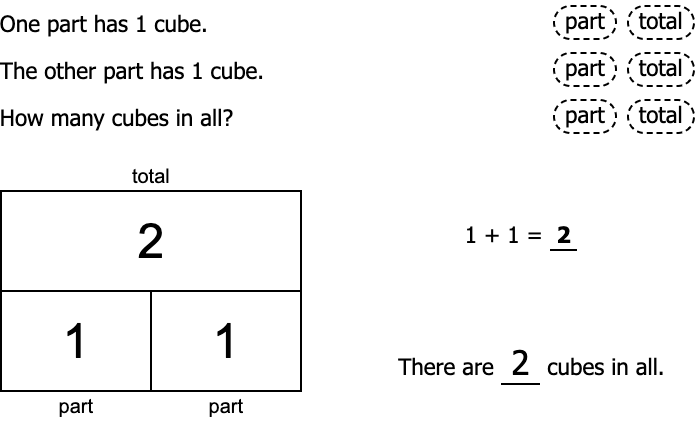
Model "Put-Together" problems.  Instead of starting with one part and adding to it, start with two parts and join them together.  If there is 1 cube in one part and 1 cube in the other part, how many cubes are there in all?  Since 1+1=2, there are 2 cubes in all.  Use a part-total model to visually show the relationship between the parts and total.


1. Learn

play_circle_outline

Model "Put-Together" problems.  Instead of starting with one part and adding to it, start with two parts and join them together.  If there is 1 cube in one part and 1 cube in the other part, how many cubes are there in all?  Since 1+1=2, there are 2 cubes in all.  Use a part-total model to visually show the relationship between the parts and total.

star_border

2. Practice

Lesson
K-51
Lesson
K-51
Lesson
K-51
star_border

3. Apply

POD
K-51
POD
K-51
POD
K-51
star_border